It happens every single day.
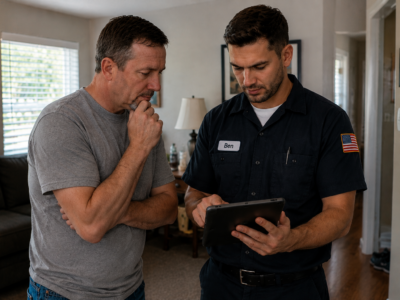
Your tech walks into a home, and before they even set their bag down, the homeowner says it:
“So, I asked ChatGPT, and I’m pretty sure it’s just the capacitor…”
In an instant, the dynamic shifts. The customer isn’t looking for an expert; they’re looking for a pair of hands to do what Chat told them to do.
And for some techs, this is where the appointment falls apart.
Why Technicians Lose Control When Customers “Do Their Research”
When a customer presents “internet research,” most technicians react in one of two ways:
- They get defensive: They try to prove the customer wrong. This creates friction, destroys trust, and turns the visit into a debate.
- They roll over: They let the customer dictate the diagnosis. They devalue the professional status of your tech.
Both reactions come from the same place: A lack of control.
The Difference Between What Google Says and What Your Tech Knows
The customer has knowledge (or at least, facts they found on a screen). But your tech has experience.
As we discussed in the latest podcast, the internet can tell you what a part does, but it can’t tell you why it failed in this specific house, with this specific ductwork, under these specific conditions.
The goal isn’t to tell the customer they’re wrong. The goal is to move them from “What” to “Why.”
What to Say When a Homeowner Diagnoses the Problem for You
If your techs are getting bullied by “Dr. Google” and “ChatGPT,” they need a new tool. Instead of arguing, they should lead with curiosity:
“I saw that same article! OR I’ve asked it myself in the past to see what it would say. It’s a great starting point. But it often misses the real issue. Now, let’s look at your system specifically to see if that applies here, because every home is a different ecosystem.”
By acknowledging the customer’s “research,” the tech lowers the defensive wall. By pivoting to the “ecosystem,” the tech re-establishes itself as the only person in the room with the full picture.
Turn the Informed Customer into a High-Value Call
Don’t let a customer who has “done their research” be an annoyance. Think of them as a customer who is highly invested in a solution. They are literally handing you the keys to a high-value conversation if you know how to drive.
Stop letting your techs lose their confidence because of “Chat GPT.” Teach them to lead with the “Why,” and the “What” will take care of itself.
ChatGPT can suggest a diagnosis to a homeowner, but it can’t give them a warranty. It can’t give them peace of mind. You aren’t selling parts; you’re selling the certainty that the job is done right.
Teaching your techs how to handle these moments — how to lead with curiosity instead of reacting with frustration — is exactly the kind of call-by-call coaching we build into the Growth Table. When your team has a process for the hard conversations, confidence follows.
 How HVAC, Plumbing, and Electrical Technicians Build a Career That Keeps Moving Forward


Leave a Reply